

How to Choose a Camping Mattress: Self-Inflating, Air Mattress or Foam
October 23, 2026

For most families and for car camping, a self-inflating mattress is the right choice: the foam inside insulates you from the cold ground and supports the body, and it packs into a roll. An air mattress is comfortable but colder at night, and a thin foam pad is the lightest and cheapest, and suits mainly treks. After choosing the type, check the thickness, the R-value and the width.
The three types of mattresses, in brief
A self-inflating mattress is open-cell foam inside an airtight shell. You open the valve, the foam expands and draws air inside, and you top it off with a few breaths or a pump. It combines the support of foam with the comfort of air.
An air mattress is a shell filled with air only. It can be thick and soft, but the air inside it is cooled by the ground, and on a cold night you feel it in your back. Some models need a separate pump.
A foam mattress (pad) is a sheet of closed-cell foam, rolled or folded. It almost never tears and needs no inflating, but it's thin, and side sleepers will feel the ground.
Comparison table
| Self-inflating | Air mattress | Foam pad | |
|---|---|---|---|
| Comfort | High, even support | High when full, less stable | Basic |
| Insulation from the ground | Good, depends on foam thickness | Weak without an insulation layer | Reasonable, depends on thickness |
| Weight | Medium to heavy | Light to medium | Very light |
| Packed size | Medium | Small | Relatively large |
| Setup | Open the valve and top off | Needs inflating | Unroll and done |
| Relative price | Medium | Low to high | Low |
| Best for | Car camping, families, cold nights | Short camping trips in warm weather | Treks and backpacking |
Thickness and R-value: what they tell you
The cold at night comes mainly from below. Your body warms what's under it, and the ground draws that heat away all night long. That's why a good sleeping bag isn't enough if the mattress doesn't insulate.
The R-value measures how well the mattress stops heat from passing through. The higher the number, the warmer the mattress. For summer camping a low value is enough; for winter nights in the desert or in the mountains, it's worth looking for a high value. When comparing, check that the value was measured by the same standard, because manufacturers don't always measure the same way.
Thickness determines comfort: side sleepers need a thicker mattress, so the shoulder and hip don't touch the ground. A thin foam pad suits back sleepers who carry every gram on their shoulders. For car camping, weight hardly matters, so it's worth going thick.
Single or double?
A single mattress is more flexible: everyone arranges their own mattress, and it also fits into a narrow tent. A double mattress is comfortable for a couple or a parent with a small child, because there's no gap in the middle to slide into at night. Before buying a double, measure the tent floor: a wide mattress in a narrow tent folds up at the edges and doesn't sit flat.
Car camping and a mattress for guests
When the car can drive right up to the campsite, there's no reason to compromise. A thick mattress with foam and a built-in pump saves you the blowing at the end of a long day, and the trip with an electric pump. And at home, the same double mattress serves as a guest bed that sets up in a minute and rolls back into the closet.
What to check in the specs before buying
- Unrolled dimensions: a length of 2 meters suits most adults. Check the width against the tent floor.
- Thickness and what it measures: the thickness of the foam, not the thickness of the inflated mattress with the seams.
- R-value and who measured it: if it's the manufacturer's figure, compare only to figures of the same kind.
- Valves: a wide deflation valve shortens the folding in the morning, and a one-way valve doesn't lose air while filling.
- Base: a non-slip surface keeps the mattress from moving on the tent floor at night.
- Carry bag: a bag with a zipper and compression straps keeps the mattress rolled and protected in the trunk.
Common mistakes when choosing a mattress
- Buying for one season. A mattress that's comfortable in August may be cold in December. If you head outdoors all year, choose for the cold nights.
- Relying on the sleeping bag. The bottom of the sleeping bag gets compressed under your body weight and insulates very little. The insulation from below comes from the mattress.
- Forgetting the ground. Small stones and thorns under the tent puncture an air mattress. Clear the area before pitching the tent, and it's worth laying a groundsheet underneath.
- Inflating all the way. A mattress that's too hard doesn't conform to the body. After lying down, release a little air until the hip sinks slightly and the back stays straight.
- Not testing at home. Unroll and fill the mattress in the living room before the first trip, to find out in advance whether the valve works and whether the size fits the tent.
How to match the mattress to the trip
One question settles most of the decision: how far will you carry the mattress? If it goes from the trunk to the tent, choose by comfort and warmth, and a few kilograms of weight don't matter. If it's carried in a pack all day, every 100 grams counts, and a foam pad or a light air mattress is better. A family heading to an overnight campsite with kids is almost always in the first case.
Our mattress: Dolomiti
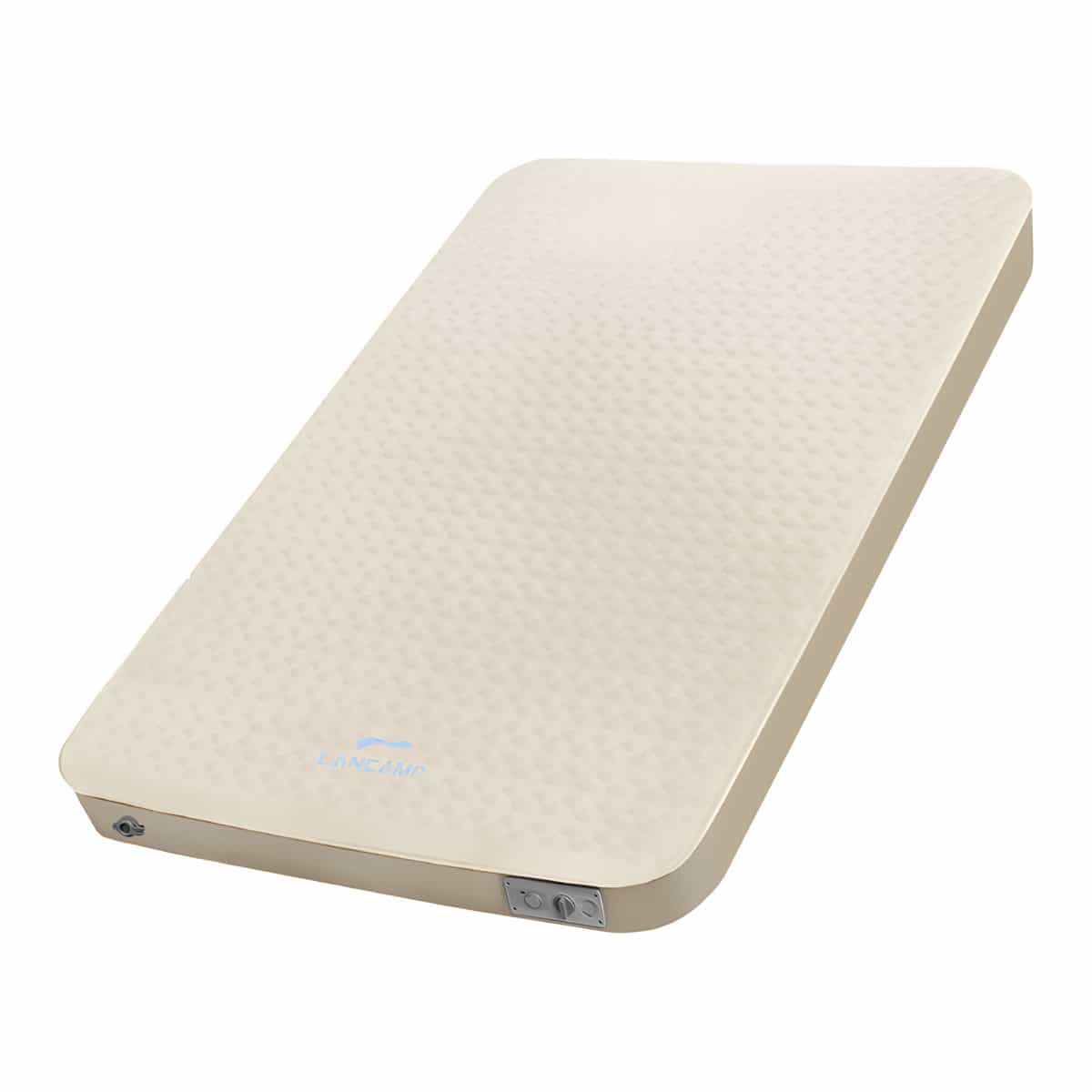
In our camping mattresses category you'll find Dolomiti, which covers most of what we described here. It's a self-inflating mattress with 10 cm thick foam and a built-in pump: turn a dial one way and it fills, the other way and it empties, with no external pump. According to the manufacturer, filling takes about 45 seconds and the R-value is 10.7.
- Single: 200×73 cm, about 2.8 kg.
- Double: 200×132 cm, about 4.8 kg, for a couple, a parent and child, or as a guest bed.
- A carry bag with a zipper and compression straps is included.
At this weight it's designed for car camping and families, not for a trek where you carry everything on your back. For a trek like that, our guide to packing a backpack will help you distribute the weight correctly. And if the nights are cold and rainy, it's also worth reading how to choose a backpack for winter.
Products in this guide

Frequently asked questions
Does a self-inflating mattress inflate completely on its own?
The foam draws in most of the air when you open the valve, but you usually top it off with a few breaths or a pump to set the firmness. With a mattress that has a built-in pump, like Dolomiti, there's no need to blow at all.
How thick should a camping mattress be?
Back sleepers can manage with a thin mattress. Side sleepers need a thicker one, so the shoulder and hip don't touch the ground. For car camping, where weight doesn't matter, a thickness of about 10 cm gives comfortable sleep.
Why am I cold at night even with a warm sleeping bag?
The fill of the sleeping bag gets compressed under your body and doesn't insulate, so the cold from the ground passes through it. The solution is a mattress with a higher R-value. An air mattress without an insulation layer is the most common cause of the problem.
How do I store a self-inflating mattress between trips?
If possible, store it laid flat or loosely rolled with the valve open, so the foam doesn't get used to being compressed. Before rolling it up, make sure it's dry so it doesn't develop a smell.
Can a camping mattress be used as a guest bed?
Yes, and a thick double mattress is especially suited for it. It sets up in a minute, gives a wide surface, and goes back into its carry bag when the guests leave.


